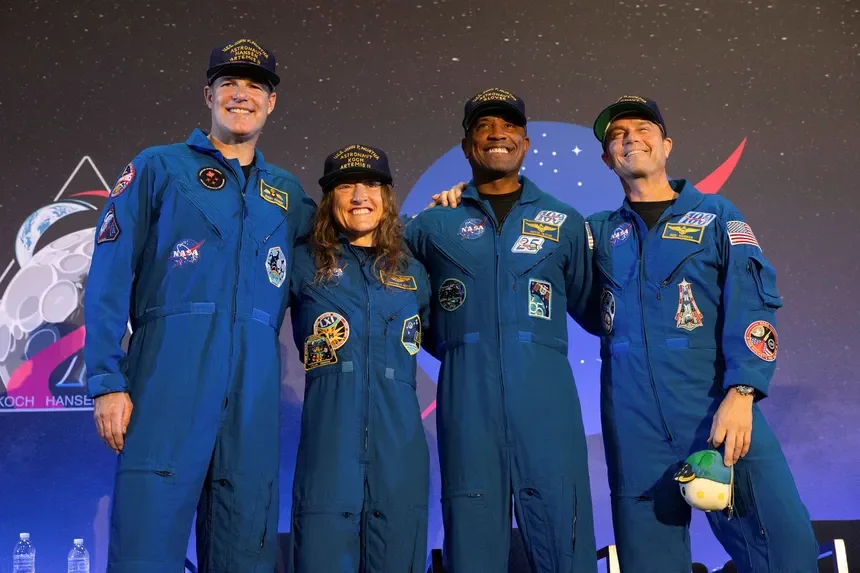
After completing a groundbreaking journey around the Moon, the four astronauts of NASA’s Artemis II mission are opening up about what it was like to return to Earth—describing the experience as both physically intense and emotionally overwhelming.
The mission marked humanity’s first crewed trip beyond low Earth orbit in more than 50 years, setting records and laying the foundation for future lunar exploration.
A Fiery and Intense Return
Re-entering Earth’s atmosphere was one of the most dramatic moments of the mission.
Astronauts described the descent as a high-speed plunge, with the Orion spacecraft enduring extreme heat and pressure before safely splashing down in the Pacific Ocean. The capsule reached speeds of nearly 30,000 miles per hour during re-entry, making it one of the fastest human returns from space.
Despite the intensity, the crew said the spacecraft performed smoothly, with only minor wear observed on its protective heat shield.
‘Surreal’ Moments in Deep Space
Throughout the mission, astronauts emphasized the emotional impact of traveling farther from Earth than any humans before.
At one point, the crew lost communication with Earth while passing behind the Moon—a moment they described as “surreal” and unlike anything experienced before.
They also witnessed rare sights, including a total solar eclipse from space, adding to what many called a once-in-a-lifetime experience.
Life After Landing: Physical and Mental Adjustment
Returning to Earth brought its own challenges.
Astronauts reported lingering sensations of weightlessness and the need to readjust to gravity after nearly 10 days in space. They are currently undergoing medical evaluations and rehabilitation as part of standard post-mission procedures.
Beyond the physical effects, the crew also spoke about the psychological transition—from the isolation of deep space back to everyday life on Earth.
Strong Bonds Formed in Space
The close quarters and shared experience created deep connections among the crew.
Astronauts described how they relied heavily on one another during the mission, with one noting that the team “launched as friends and came back as best friends.”
This camaraderie was seen as essential to managing both the technical and emotional demands of the journey.
A Mission That Inspires the World
The Artemis II mission has drawn global attention, with astronauts expressing surprise at the level of public interest and support after their return.
The crew highlighted the broader significance of the mission—not just as a technological achievement, but as a symbol of international cooperation and human exploration.
Looking Ahead
Artemis II is a key step in NASA’s long-term plan to return humans to the Moon and eventually send astronauts to Mars.
With the success of this mission, attention now turns to Artemis III, which aims to land astronauts on the lunar surface for the first time in decades.
For the crew, however, the focus remains on processing an experience few humans have ever had—traveling to the Moon and back, and returning home safely.